Shopping centres are part of everyday life in Australia. They are where people work, shop, meet friends, take children, attend appointments, pick up groceries, grab dinner and pass through on the way home.
Most visits are normal and uneventful. But when something does happen, an aggressive customer, a theft, a medical emergency, a missing child, a shopping centre lockdown, a suspicious person or a security incident, the difference between confusion and calm often comes down to communication.
That is why shopping centre safety in Australia is becoming a bigger conversation in 2026. The issue is not just crime. It is also how shoppers, retail workers, security teams and centre management communicate when something happens.
This guide explains current shopping centre crime trends, how to check crime near your area, what to do if you feel unsafe, and how better coordination can help protect visitors, staff, retailers and security teams.
Why Shopping Centre Safety in Australia Is Getting More Attention
Retail crime and public-place safety have become major talking points across Australia.

The Australian Bureau of Statistics reported that theft reached a 21-year high, with thefts at retail locations rising from 32% of all thefts in 2010 to 45% in 2024. Victoria recorded the largest annual rise in theft, up 29%, followed by Tasmania at 11%.
The Australian Retail Council has also warned about rising retail crime and aggression. In 2025, it reported that 70% of retailers had seen customer theft increase over the previous financial year, 51% experienced physical abuse monthly or more often, 87% of retail workers reported verbal abuse, and around 800,000 retail crime incidents were reported across Australia in the past year.
This does not mean Australian shopping centres are unsafe places to visit. It means the safety environment has changed. Centres are no longer just retail destinations. They are large public environments with hundreds or thousands of people, multiple tenants, car parks, food courts, cinemas, medical services, transport links and security responsibilities.
That makes shopping centre safety in Australia a coordination issue as much as a security issue.
Are Australian Shopping Centres Safe?
In general, shopping centres are designed to be controlled, staffed and monitored environments. They usually have security teams, centre management, CCTV, emergency procedures, tenant communication channels and relationships with local police.
The better question is not simply: “Are shopping centres safe?”
The better question is:
When something happens, how quickly can the right people find out, respond and communicate clearly?
That matters because shopping centre incidents can involve different groups at the same time:
- shoppers and families
- retail worker safety Australia
- store managers
- centre management
- security teams
- cleaners and facilities staff
- emergency services
- nearby tenants
- car park teams
- first aid responders
When communication is clear, incidents can be handled faster and with less confusion. When communication is fragmented, even a small incident can feel chaotic.
The Most Common Shopping Centre Safety Concerns
Shopping centre safety in Australia covers more than theft. Different centres face different risks depending on location, foot traffic, opening hours, tenant mix, transport access and local crime trends.
Common safety concerns include:
1. Theft and shoplifting
Retail theft is one of the biggest issues facing stores inside shopping centres. It affects major retailers, small businesses, pharmacies, supermarkets, electronics stores, fashion stores and convenience retailers.
The problem is not only lost stock. Theft can also create confrontation between staff, offenders, security and other customers.
2. Aggressive or abusive customers
Retail workers are often the first people exposed to aggression. This can include shouting, threats, intimidation, harassment, verbal abuse, physical abuse or customers refusing to leave.
Safe Work Australia recognises workplace violence and aggression as incidents where a person is abused, threatened or assaulted at work or while carrying out work. It also notes that businesses have work health and safety duties to manage these risks.
3. Youth disturbances and anti-social behaviour
Some centres experience groups gathering around food courts, entertainment precincts, car parks or transport-linked areas. Most young people are not a safety risk, but anti-social behaviour can create stress for retailers, customers and security teams when it escalates.
4. Medical emergencies
Shopping centres are large public spaces, so medical incidents happen. A person may collapse, experience chest pain, suffer a fall, have a seizure, become disoriented or need urgent first aid.
In these situations, fast location sharing matters. The exact store, level, entrance, car park zone or food court area can make a major difference.
5. Missing children or vulnerable people
Parents and carers can become separated from children, elderly relatives or vulnerable people in busy centres. Food courts, playgrounds, toilets, cinemas, department stores and car parks are common areas where separation can happen.
6. Suspicious behaviour
Suspicious behaviour may include someone appearing to follow another person, loitering around vehicles, acting aggressively, filming staff, repeatedly entering stores without purchasing, or behaving in a way that makes others feel unsafe.
Crime Stoppers Australia and the Shopping Centre Council of Australia have publicly encouraged people to share information if they witness crime or suspicious activity around shopping centre environments.
7. Car park safety concerns
Many people feel less comfortable in car parks than inside the centre itself. Concerns may include poor lighting, isolated areas, vehicle break-ins, people loitering near cars, difficulty finding help, or walking alone at night.
8. Shopping Centre Lockdown, evacuations and emergency alerts
Most shoppers will never experience a major shopping centre emergency. But centres need procedures for fires, threats, violent incidents, severe weather, gas leaks, police operations and other events requiring evacuation, shelter-in-place or lockdown-style instructions.
How To Check Crime Trends Near a Shopping Centre
Public crime data can help you understand local trends near a shopping centre, suburb or route. It should be used carefully.
Crime maps usually show suburb, postcode, local government area or police district data. They do not always show what happened inside a specific shopping centre. They also do not tell you whether a centre handled incidents well, how much foot traffic it had, or how many events were reported compared with the number of daily visitors.
Western Australia Police specifically notes that crime statistics can be influenced by factors such as population size, infrastructure including shopping centres and entertainment precincts, seasonal trends, and the extent to which crime is reported or detected by police.
Still, official crime tools can be useful if you want to understand broader local patterns.
Queensland
Queensland Police provides an online crime map showing types of crimes that happened in Queensland over the past five years.
New South Wales
The NSW Bureau of Crime Statistics and Research provides a Crime Mapping Tool that helps users find information on crime incidents, offenders and victims recorded by the NSW Police Force. Users can search by boundaries such as local government area, postcode, statistical area or suburb.
Victoria
The Crime Statistics Agency Victoria provides local crime statistics through interactive tools, with data available by local government area, postcode and other areas.
South Australia
SAPOL provides an interactive suburb-level crime mapping tool with information about crimes against the person and crimes against property in suburb or postcode areas.
Western Australia
WA Police publishes crime statistics and data by location, including reports and data tables. It also explains that interpretation should consider local factors such as population, infrastructure, reporting and detection.
ACT
ACT Policing provides criminal offence data for the Australian Capital Territory, with quarterly and monthly data available for download.
Northern Territory
Northern Territory crime statistics are updated monthly and prepared using data recorded by NT Police.
Crime Map Australia
To view the country as a whole, this Crime Map Australia by Red Suburbs gives a good indication of crime, country wide.
Are Some Shopping Centres More Dangerous Than Others?
Some areas experience more reported crime than others. But ranking individual shopping centres from “most dangerous” to “safest” is usually not fair or accurate unless the ranking accounts for:
- foot traffic
- number of stores
- car park size
- transport access
- local suburb crime levels
- opening hours
- event activity
- tenant mix
- reporting rates
- police activity
- centre response processes
- number of incidents per visitor
A large centre with millions of visitors may naturally have more reported incidents than a smaller centre, even if the risk per visitor is low.
That is why shopping centre safety in Australia should be viewed through a practical lens: not fear, not blame, but preparedness and response.
The useful questions are:
- Can visitors find help quickly?
- Can retail workers contact security easily?
- Can security teams receive the right information fast?
- Can centre management see what is happening across different zones?
- Can incidents be documented clearly?
- Can tenants and security communicate without confusion?
- Can people share their location with trusted contacts if they feel unsafe?
Those questions matter more than a simple “best to worst” list.
What To Do If You Feel Unsafe in a Shopping Centre
If you feel unsafe in a shopping centre, take action early. You do not need to wait until something becomes serious. There are steps to help improve shopping centre safety in Australia.
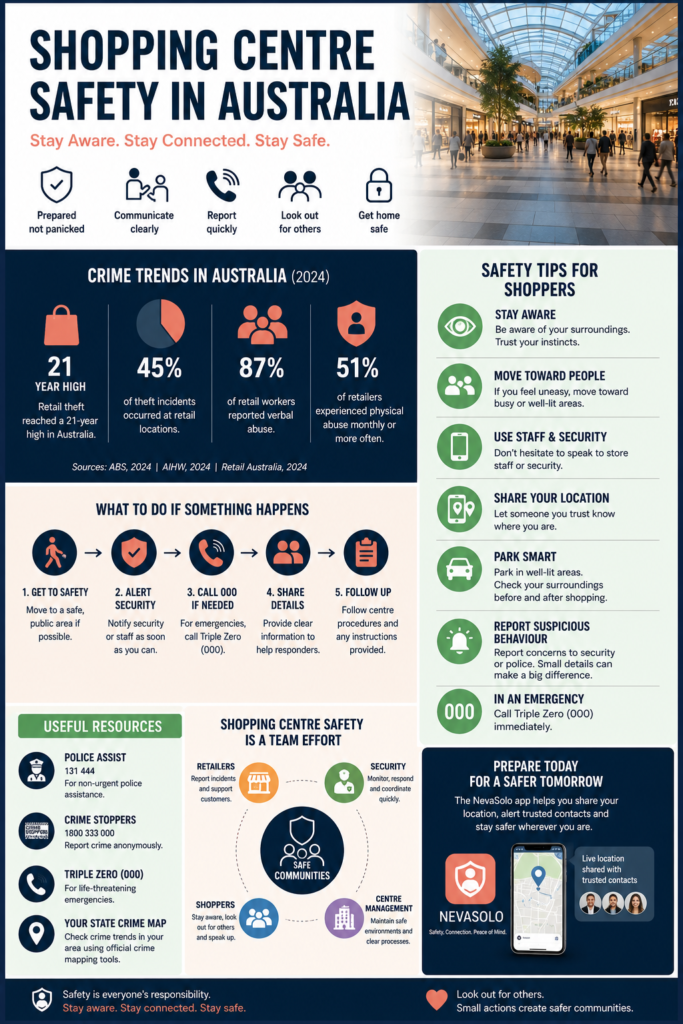
1. Move toward people, light and staff
Walk toward a staffed area such as a service desk, supermarket, pharmacy, major retailer, food court, security desk or busy walkway.
Avoid isolated exits, stairwells, quiet car park levels or empty corridors if they make you feel more exposed.
2. Contact centre security or staff
Tell a staff member or security guard what is happening. Be specific:
- where you are
- who or what is concerning you
- what direction the person moved
- whether anyone is hurt
- whether you need someone to walk with you
- whether you need help reaching your car, transport or another person
3. Do not confront someone unnecessarily
If someone is aggressive, suspicious or threatening, create distance. Let trained staff, security or police handle the situation.
4. Share your location with someone you trust
If you are alone or uncomfortable, tell a trusted contact where you are. Share your live location if appropriate.
South Australia Police recommends planning and sharing route or destination details, letting a trusted person know your plans, considering live location sharing, and thinking about whether someone trusted would know where you are if something went wrong.
5. Use a personal safety app before you need it
Personal safety apps can help people send emergency alerts, share location with trusted contacts, access SOS functions, discreetly contact emergency contacts, and access safety information. 1800RESPECT notes that people should consider whether an app suits their needs, is accessible, is easy to use and only asks for information that is needed.
NevaSolo is designed to help users share safety sessions, trips and incident alerts with trusted contacts, so the right people can better understand what is happening when it matters.
6. Call Triple Zero if there is immediate danger
If someone is seriously injured, your life or property is being threatened, or you have witnessed a serious accident or crime, call Triple Zero (000). Triple Zero is the quickest way to contact police, fire or ambulance in life-threatening or emergency situations.
A personal safety app can support your safety planning, but it does not replace Triple Zero in an emergency.
What Retail Workers Should Do During a Shopping Centre Incident
Retail workers are often the first to notice when something is wrong.
A staff member may see shoplifting, aggressive behaviour, a medical emergency, a person being followed, a child separated from a parent, or a situation that feels like it could escalate.
The right response depends on store policy, centre procedures and the seriousness of the incident. But these principles can help.
1. Prioritise safety over stock
No product is worth a worker being injured. If someone is aggressive, armed, unpredictable or threatening, move away and alert the appropriate people.
2. Use the approved reporting channel
Every store should know how to contact centre security. This may be by phone, radio, duress system, internal platform or centre management process.
The challenge is that many shopping centres still rely on fragmented communication. A worker may have a phone number, another tenant may use radio, security may use a separate system, and centre management may not see the full picture until later.
3. Give clear incident information
When reporting an incident, include:
- exact location
- store name
- type of incident
- number of people involved
- physical description if relevant
- direction of travel
- whether anyone is injured
- whether police, ambulance or fire may be needed
- whether the person is still present
- whether staff or customers need immediate support
4. Keep customers away from the risk
If safe, guide customers away from the area. Use calm, simple language. Avoid creating panic.
5. Record what happened
After the incident, document what occurred according to your workplace process. Include times, names, actions taken, security response, injuries, property damage and any follow-up required.
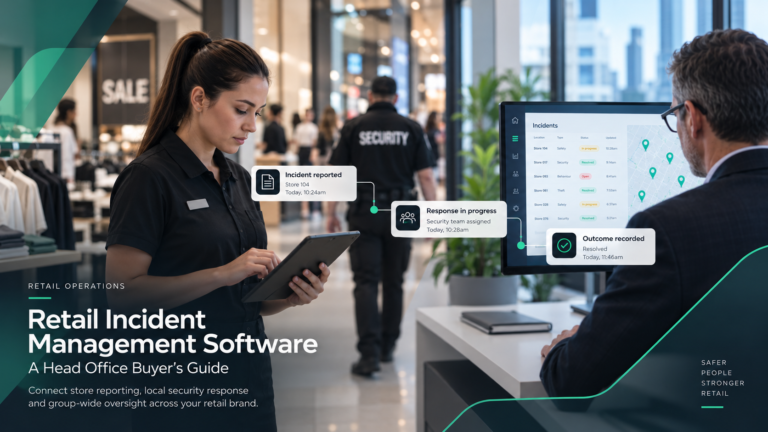
This is where structured incident reporting helps. NevaSolo Enterprise is designed to support structured, event-based coordination during safety-related situations, including incident reporting, targeted notifications, responsibility assignment and tracking progress through to resolution.
Why Communication Breaks Down During Shopping Centre Incidents
Shopping centres are complex environments. A single incident can involve a tenant, security guard, centre manager, cleaner, customer, first aider and emergency service.
Communication can break down when:
- staff do not know who to contact
- different stores use different processes
- security receives incomplete information
- centre management does not have real-time visibility
- multiple people report the same incident separately
- updates are spread across phone calls, radios and messages
- no one knows who has taken responsibility
- incident notes are written after the fact
- there is no clear escalation history
- tenants are unsure when an incident has been resolved
This is a major opportunity for shopping centre safety in Australia.
Better communication does not mean creating panic. It means giving the right people the right information at the right time.
For centres, this can mean:
- faster incident awareness
- clearer escalation
- better tenant participation
- more accurate incident records
- less duplicated communication
- improved visibility across zones
- stronger post-incident review
- more confidence for retailers and security teams
For shoppers, it can mean knowing who to contact, where to go, and how to keep trusted people informed.
How Shopping Centres Can Improve Safety Coordination
Modern shopping centre safety is not only about guards, cameras and patrols. It is also about systems, training and communication.
Here are practical ways centres can improve safety coordination.
1. Make reporting simple for tenants
Retail workers should not need to search for a number or wonder who to call. Every tenant should know exactly how to report:
- theft
- spills
- aggressive behaviour
- medical incidents
- suspicious activity
- missing children
- hazards
- car park concerns
- emergency situations
2. Use zone-based incident visibility
Large centres should be able to understand where incidents are happening: food court, car park, loading dock, supermarket mall, entertainment precinct, amenities, entry points or specific levels.
Zone-based visibility helps security and management respond with more context.
3. Create clear escalation pathways
Not every incident needs police. Not every issue needs a full emergency response. But every incident needs a clear pathway.
A centre should know when to:
- notify security
- notify centre management
- notify a tenant manager
- notify first aid
- contact police
- contact ambulance
- contact fire services
- issue wider instructions
- record the matter for follow-up
4. Keep tenants informed during active incidents
Retailers need to know what is relevant to them. Too little information creates uncertainty. Too much information creates noise.
Role-based communication helps ensure authorised people receive the updates they need without unnecessary exposure.
5. Build post-incident records
After an incident, centres and retailers should be able to review:
- what happened
- who reported it
- when it was escalated
- who responded
- what actions were taken
- whether police or emergency services were contacted
- when it was resolved
- what follow-up is required
Good records help with safety improvement, insurance, governance, staff training and tenant confidence.
6. Encourage community reporting
The Shopping Centre Council of Australia and Crime Stoppers Australia have supported campaigns encouraging people to speak up if they witness crime or suspicious behaviour in shopping centre environments.
This is the right type of community safety message: not fear-based, not blaming centres, but encouraging awareness and information sharing.
How NevaSolo Supports Shopping Centre Safety
NevaSolo is built around a simple idea: when something is happening, the right people need clarity.
For individuals, NevaSolo helps people share safety sessions, trips and incident alerts with trusted contacts. That can be useful when someone is heading home alone, walking through a car park, meeting someone, travelling at night or simply wanting someone they trust to know where they are.
For organisations, NevaSolo Enterprise supports structured coordination during safety-related situations. It is designed for environments where incidents may be reported inconsistently, communication may be fragmented, responsibility may be unclear and documentation may be incomplete.
For shopping centres, that means NevaSolo can support:
- tenant-to-security incident reporting
- retailer safety escalation
- authorised alerts
- event-based coordination
- incident notes and context
- responsibility assignment
- progress tracking
- clearer communication between retailers, security and centre management
Shopping centre safety in Australia is not about creating fear. It is about helping people act earlier, communicate faster and coordinate better when something happens.
Shopping Centre Safety Tips for Visitors
Before your next visit, especially at night or when travelling alone, consider these simple steps.
Before you go
- Tell someone where you are going if you are concerned.
- Make sure your phone is charged.
- Save important contacts.
- Know where you parked.
- Check your route home.
- Set up trusted contacts in your safety app.
- Be aware of centre closing times.
While you are there
- Stay aware of your surroundings.
- Avoid isolated areas if they make you uncomfortable.
- Move toward staff if something feels wrong.
- Do not confront aggressive people.
- Report suspicious behaviour to centre staff or security.
- Keep children close in busy areas.
- Agree on a meeting point with family or friends.
When leaving
- Walk with someone if possible.
- Use well-lit exits.
- Ask security for assistance if you feel unsafe.
- Share your live location with a trusted contact if needed.
- Have keys ready before reaching your car.
- Leave the area if something feels wrong.
- Call Triple Zero in an emergency.
Shopping Centre Safety Tips for Retailers
Retailers inside shopping centres can strengthen staff safety by making incident response simple and repeatable.
Train staff on what to report
Staff should know how to report:
- aggressive customers
- theft
- suspicious behaviour
- medical incidents
- threats
- harassment
- hazards
- missing children
- emergency situations
Make security contact easy
Security contact details should be easy to find and available to every staff member, including casual and junior staff.
Avoid relying only on memory
During stressful incidents, people forget details. Structured reporting helps staff capture important information quickly.
Support young and casual workers
The Australian Retail Council has noted that more than half of retail workers are women and more than a third are aged 15–24, which can increase vulnerability to violent repeat offenders.
Young workers and casual staff need clear, simple instructions. They should know they are not expected to physically intervene in unsafe situations.
Review incidents regularly
Every incident is a chance to improve. Retailers and centre management should review patterns, response times, communication issues and follow-up actions.
Frequently Asked Questions About Shopping Centre Safety in Australia
Are shopping centres in Australia safe?
Most shopping centre visits in Australia are routine. However, retail theft, customer aggression, medical incidents, suspicious behaviour and emergency events can occur. The key safety issue is whether shoppers, retailers, security and centre management can communicate clearly when something happens.
Why is shopping centre safety in Australia being discussed more in 2026?
Retail crime and worker safety have become more visible. ABS data shows theft reached a 21-year high, and retail locations made up a larger share of thefts in 2024 than in 2010. Retail industry data has also highlighted high rates of verbal abuse, physical abuse and reported retail crime incidents.
Can I check crime near a shopping centre?
Yes. You can use official state and territory crime tools to check local crime trends by suburb, postcode, local government area or police district. These tools help you understand the broader area, but they usually do not provide a complete centre-specific safety ranking.
What should I do if I feel unsafe in a shopping centre?
Move toward a staffed, well-lit or busy area. Contact centre security or staff. Share your location with someone you trust. Avoid confrontation. If there is immediate danger, serious injury or a crime in progress, call Triple Zero (000).
What should retail workers do during a security incident?
Retail workers should prioritise personal safety, avoid unnecessary confrontation, alert security through the approved process, give clear location and incident details, guide customers away from danger if safe, and record what happened according to workplace procedures.
What is a shopping centre incident coordination platform?
A shopping centre incident coordination platform helps authorised users report incidents, send targeted notifications, assign responsibility, share relevant context, track progress and document resolution. For centres with many tenants and security workflows, this can reduce confusion and improve response coordination.
How can a personal safety app help shoppers?
A personal safety app can help people share location, send alerts to trusted contacts, use SOS-style features and stay connected when they are travelling, walking alone, leaving a centre at night or feeling unsafe. Safety apps should support personal safety planning, while Triple Zero remains the emergency number for immediate danger.
Safety Is About Coordination, Not Fear
Shopping centres are important community spaces. The goal is not to make people afraid of visiting them.
The goal is to make safety easier to act on.
For shoppers, that means knowing what to do if something feels wrong.
For retail workers, it means having clear ways to report incidents and get help.
For security teams, it means receiving accurate information quickly.
For centre managers, it means better visibility, stronger documentation and more confidence across the whole environment.
Shopping centre safety in Australia will keep evolving. The centres that handle it best will be the ones that treat safety as a shared responsibility between visitors, retailers, security teams, centre management, police and the wider community.
When people can communicate clearly, respond earlier and keep the right people informed, shopping centres become safer, calmer and better places for everyone.
Stay Connected When It Matters Most
Whether you are heading home alone, working late in retail, managing a store or coordinating safety across a large venue, NevaSolo helps the right people stay informed when something happens.
For personal safety, use NevaSolo to share trips, safety sessions and incident alerts with trusted contacts.
For shopping centres, retailers and security teams, NevaSolo Enterprise supports structured incident coordination, targeted notifications, responsibility assignment and clearer communication from report through to resolution.

1 Comment
Shopping Centre Communication: Connect Tenants & Security · 10/10/2026 at 6:34 pm
[…] For the broader context, read our guide to shopping centre safety in Australia. […]