Retail worker safety Australia-wide is becoming one of the biggest workplace safety issues facing stores, shopping centres, security teams and retail managers in 2026.
Retail workers are often the first people exposed to customer abuse, theft, aggressive behaviour, threats, intimidation, harassment, shoplifting confrontations, medical incidents and late-shift safety concerns. For many workers, especially young staff and casual employees, the hardest part is not only what happens in the moment. It is knowing who to contact, how to report it, whether anyone has seen the report, and what happens next.
That is why this retail worker safety Australia guide focuses on practical action.
This article explains what is happening in Australian retail, what staff should do if a customer becomes aggressive, when to call security or police, why incidents often go unreported, and how better communication between workers, managers, security teams and shopping centres can help retail staff feel safer.
Quick Answer: What Should Retail Workers Do If They Feel Unsafe?
If a retail worker feels unsafe, they should move away from the risk, alert a manager or security as early as possible, avoid physical confrontation, record clear details, and call Triple Zero on 000 if there is immediate danger, serious injury, a crime in progress or urgent police, fire or ambulance assistance is needed. Triple Zero is Australia’s emergency number for life-threatening or time-critical situations.
A simple retail worker safety response looks like this:
- Move to a safer position.
- Keep distance from the person or incident.
- Alert a manager, security or authorised contact.
- Avoid arguing, chasing or physically intervening.
- Share clear details: location, description, risk level and direction of travel.
- Call Triple Zero on 000 if there is immediate danger.
- Report and document what happened after the incident.
The goal is simple: retail workers should not feel alone when something happens.
Why Retail Worker Safety Australia Matters in 2026
Retail is one of Australia’s largest employment sectors. The Australian Retail Council says the sector employs more than 1.4 million people and is Australia’s largest private-sector employer.

That means retail worker safety Australia-wide is not a small workplace issue. It affects supermarkets, pharmacies, shopping centres, department stores, bottle shops, petrol stations, convenience stores, fashion retailers, fast food outlets, hardware stores, electronics shops, discount retailers and independent businesses.
Retail workers are often dealing with the public all day, every day. Safe Work Australia notes that retail work usually involves interacting with the public, which may increase the risk of exposure to violence and harassment.
The issue has become more visible because retail crime, customer aggression and workplace violence are now being discussed by police, regulators, unions, retailers, governments and shopping centre industry groups.
The Australian Bureau of Statistics reported that theft reached a 21-year high, with almost half of “other theft” occurring in retail locations in 2024. The Australian Retail Council also reported that 70% of retailers had seen customer theft increase, 51% experienced physical abuse monthly or more often, 87% of retail workers reported verbal abuse, and around 800,000 retail crime incidents were reported across Australia in the past year.
These figures show why retail worker safety is no longer just a store-level issue. It is a national safety, workplace and community issue.
Retail Worker Safety Australia Snapshot
| Issue | What the data shows |
|---|---|
| Retail theft | Theft reached a 21-year high in Australia, and almost half of other theft occurred in retail locations in 2024. |
| Customer theft | 70% of retailers reported increased customer theft. |
| Verbal abuse | 87% of retail workers reported experiencing verbal abuse. |
| Physical abuse | 51% of retailers experienced physical abuse monthly or more often. |
| Retail crime incidents | Around 800,000 retail crime incidents were reported across Australia in the past year. |
| Retail workforce | Retail employs more than 1.4 million people in Australia. |
The important takeaway is this: retail worker safety Australia-wide is not only about preventing extreme events. It is about making sure everyday incidents are taken seriously, reported properly and responded to clearly.
What Counts as a Retail Worker Safety Issue?
Retail worker safety covers more than physical assault.
A safety issue can include anything that creates a risk to a worker’s physical or psychological health while they are doing their job. Safe Work Australia describes workplace violence and aggression as situations where a person is abused, threatened or assaulted at work or while working, and notes that this can cause both physical and psychological harm.
Common retail worker safety issues include:
- verbal abuse
- yelling or swearing
- threats
- intimidation
- stalking or harassment
- aggressive body language
- customers refusing to leave
- shoplifting confrontations
- armed robbery
- physical assault
- sexual harassment
- spitting
- racism or discriminatory abuse
- customers filming or targeting staff
- repeat abusive customers
- car park intimidation
- lone work risks
- late-night closing risks
- medical emergencies involving customers or staff
- suspicious behaviour near the store
- stress after repeated incidents
A worker does not need to be physically injured for an incident to matter. Abuse, intimidation and repeated aggression can still affect confidence, mental health, job satisfaction and staff retention.
Real-World Retail Worker Safety in Australia
Retail worker safety Australia-wide is being taken more seriously because the problem is showing up in real data, legal reforms, industry campaigns and policing strategies.
NSW: Stronger penalties and a retail crime strategy
In New South Wales, it became an offence in 2023 to assault, throw a missile at, stalk, harass or intimidate a retail worker in the course of duty, even where no actual bodily harm is caused. The maximum penalty for that offence is four years’ imprisonment, while assault causing actual bodily harm carries a maximum of six years.
NSW also launched a Retail Crime Strategy with the statewide rollout of Operation Percentile, a policing model targeting repeat and high-harm retail offenders. The NSW Government says the strategy tackles assaults, intimidation, threats of violence, repeat offending and theft, with elements including high-visibility policing, intelligence-led operations, knife scanning in retail precincts, dedicated police contacts and retailer safety packs.
This is a clear signal that retail worker safety is now being treated as a serious public safety issue, not just a customer service problem.
Western Australia: Specific offence for assaulting retail workers
Western Australia introduced a specific “assault retail workers” offence, with people who attack staff in the course of their duties facing up to seven years in prison. The WA Government said the tougher sentencing options are notably higher than previous penalties.
This matters because it reinforces a simple principle: retail workers should not be attacked for doing their job.
South Australia: Workplace Protection Orders
South Australia introduced Workplace Protection Order laws designed to stop repeat offenders returning to workplaces where they have threatened, abused or assaulted staff. The South Australian Attorney-General’s Department says breaches can carry penalties of up to two years’ imprisonment for a non-aggravated breach and five years for an aggravated breach.
In May 2026, the South Australian Government said these laws allow retailers and authorities to prevent high-harm repeat offenders from entering stores.
For retailers, this highlights the importance of good incident records. If a repeat offender keeps returning, stores need clear information about what happened, when it happened, who was involved and what action was taken.
Victoria: Proposed stronger worker harm laws
Victoria announced the Crimes Amendment (Retail, Fast Food, Hospitality and Transport Worker Harm) Bill 2025, with a proposed indictable offence carrying up to five years in jail for assaulting or threatening to assault customer-facing workers. Lower-level assaults and threatening or intimidating conduct would carry penalties of up to six months in jail.
Victoria Police also provides practical advice for staff responding to aggressive customers, including staying calm, listening with empathy, offering solutions, staying safe and calling for help.
Shopping centres and retail groups are already campaigning on this issue
The Shopping Centre Council of Australia’s “Be Kind in Retail” campaign brought together shopping centre, retail, fuel and convenience, pharmacy, security and cleaning industry groups to combat abuse, violence and the use of weapons against workers.
The 2025 campaign ran across more than 350 participating shopping centres and retail precincts and more than 3,500 digital screens during the Christmas trading period.
That is important because it shows retail worker safety is already a shared issue between stores, shopping centres, security teams, cleaners, pharmacy workers, fuel and convenience retailers and centre management.
Why Customer Abuse Happens in Retail
Customer abuse can happen for many reasons. Understanding the triggers does not excuse the behaviour. It helps retailers prepare staff, improve processes and reduce escalation.
Common triggers include:
- refund or exchange disputes
- long wait times
- stock shortages
- self-checkout frustration
- refusal of service
- alcohol, tobacco or restricted product issues
- theft confrontations
- bag checks
- price disputes
- delivery or click-and-collect delays
- customers being asked to leave
- queue pressure during peak periods
- repeat offenders returning to the same store
- frustration during Christmas, sales or holiday periods
- understaffing or lack of visible support
Many retail incidents begin as a normal customer interaction and escalate quickly. That is why staff need a clear way to ask for help early.
Retail workers should not have to wait until a situation becomes violent before reporting it.
What Retail Workers Should Do If a Customer Becomes Aggressive
When a customer becomes aggressive, retail staff need simple steps they can remember under pressure.
Victoria Police advises staff responding to aggressive customers to stay calm, listen with empathy, offer solutions, stay safe and call for help.
Here is a practical retail worker safety response.
1. Stay calm and keep your voice steady
A calm voice can help reduce tension. Avoid shouting back, sarcasm or sudden movements.
Use short, clear phrases:
- “I’m here to help.”
- “I need you to lower your voice.”
- “Let me get my manager.”
- “I can explain the policy.”
- “I’m going to step back now.”
2. Create distance
Step back if the customer is leaning over the counter, moving closer or blocking your space.
Use natural barriers where possible, such as:
- counters
- display stands
- shelving
- service desks
- checkout areas
- doorways
- staff-only zones
Distance gives staff more time to think, speak and call for help.
3. Do not physically intervene
Retail workers should avoid chasing, grabbing, blocking or physically confronting a person unless they are specifically trained, authorised and it is safe to do so.
No product is worth a worker being injured.
4. Alert someone early
Call a manager, security, another staff member or centre control before the situation becomes serious.
Early reporting is important. A worker should not have to decide whether the incident is “bad enough” to ask for help.
If someone feels unsafe, that is enough reason to escalate.
5. Move other staff and customers away if safe
If the incident is escalating, calmly create space around the area.
Simple instructions help:
- “Please move this way.”
- “We’re going to give this area some space.”
- “Please wait near the front of the store.”
- “Security has been contacted.”
6. Call Triple Zero if there is immediate danger
Call Triple Zero on 000 if someone is seriously injured, your life or property is being threatened, or you have witnessed a serious accident or crime.
This includes situations involving violence, weapons, serious threats, medical emergencies, fire, or an active crime where urgent help is needed.
7. Report what happened after the incident
After the immediate risk has passed, record what happened while details are fresh.
Include:
- date and time
- store location
- staff involved
- what triggered the incident
- what the person said or did
- physical description if relevant
- whether threats were made
- whether anyone was injured
- whether police, security or ambulance attended
- what actions were taken
- whether follow-up is required
Good reporting protects staff, helps managers identify patterns and gives security or centre management better context.
When Should Retail Workers Call Security?
Retail staff should call security when a situation is escalating or when store staff need support.
Call security when:
- a customer is yelling, threatening or intimidating staff
- someone refuses to leave
- suspected theft is creating a confrontation
- a person is following staff or customers
- a group is causing disruption
- someone appears intoxicated, erratic or unsafe
- a person is loitering near the store, staff exit or car park
- staff feel unsafe walking to or from the store
- there is suspicious behaviour near stock, registers or exits
- a medical incident requires centre support
- a lost child or vulnerable person needs assistance
- a hazard could affect customers or staff
In shopping centres, this is where clear tenant-to-security communication matters. A staff member should not have to search through a handbook, old email or group chat to find the right number while something is happening.
When Should Retail Workers Call Police?
Retail workers, store managers or security should contact police when there is violence, a serious threat, a crime in progress, a weapon, serious injury or immediate danger.
WorkSafe Victoria says employers should contact police on Triple Zero when someone is in immediate danger, a crime is in progress or immediate police attendance is needed. It also says that referring a matter to police does not mean employers take no internal action, because reports of aggression or violence in the work environment remain occupational health and safety matters.
Call Triple Zero on 000 for urgent situations.
For non-urgent incidents, follow your workplace process and contact the relevant police assistance line or local police station where appropriate.
The key is to make escalation clear before an incident happens. Staff should know:
- who to call first
- when to call security
- when to call police
- what details to provide
- how to report the incident internally
- what support is available afterward
Why Retail Worker Safety Incidents Often Go Unreported
One of the biggest retail worker safety problems is underreporting.
WorkSafe Victoria says aggression or violence is underreported, especially in industries where employees are frequently exposed to it. It identifies reasons such as complicated reporting processes, workplace culture, fear of blame, uncertainty about what is reportable, and incidents happening so often that only serious ones are reported.
This happens in retail all the time.
A worker may not report an incident because:
- they think abuse is “part of the job”
- they do not know if the incident is serious enough
- the reporting process takes too long
- they are busy serving customers
- they are a casual worker and do not know the process
- they do not want to be blamed
- they think nothing will happen
- they have reported before and never received follow-up
- the manager is not on site
- security is hard to reach
- the incident happens near closing time
- there is no easy way to attach details or evidence
- the report depends on memory after a stressful shift
This is where retailers have a major opportunity.
Retail worker safety Australia-wide will improve when stores make reporting easier, faster and more useful for frontline staff.
The Retail Safety Problem: Staff Are Told to “Report It”, But Reporting Is Often Too Hard
Many retail workers are told:
- “Call security.”
- “Tell your manager.”
- “Fill out an incident form.”
- “Let us know if it happens again.”
- “Document everything.”
That advice is reasonable, but it often breaks down in real life.
A worker dealing with an aggressive customer may not have time to find a number, open a long form, leave the counter, explain the situation twice, or work out whether the issue should go to a manager, security, police or centre management.
This creates a gap between policy and reality.
The better approach is to make reporting simple enough that staff can use it during a real shift.
A good retail incident report should quickly capture:
- what happened
- where it happened
- whether anyone is injured
- whether the person is still there
- whether security is needed
- whether police may be needed
- who has been notified
- what action has been taken
- whether follow-up is required
That is the difference between a safety policy and a safety pathway.
Real-World Scenario: A Customer Becomes Aggressive at the Counter
A customer is arguing about a refund. The staff member explains the policy, but the customer starts yelling, leaning over the counter and refusing to leave.
Other workers notice, but they are not sure whether to call the manager, centre security or police.
The worker feels exposed because the situation is happening in front of customers and there is no clear way to quietly raise the alarm.
What helps
The staff member needs a simple way to alert the right people, share the store location, explain what is happening and receive support before the situation escalates.
How NevaSolo Enterprise helps
NevaSolo Enterprise is designed for structured incident reporting, targeted notifications, responsibility assignment and progress tracking during safety-related situations. Authorised users can submit incidents, attach relevant context, notify the right people and track progress through to resolution.
For a retailer, that means a staff member does not have to rely on memory, scattered phone numbers or informal messages when something feels unsafe.
Real-World Scenario: A Shoplifting Incident Starts to Escalate
A worker sees someone leave with unpaid stock. The worker does not want to confront the person, but they need security to know what happened, where the person went and whether anyone is at risk.
In many stores, this becomes a rushed phone call or a message in a group chat.
Important details can be missed:
- what the person looked like
- what they took
- which exit they used
- whether they were alone
- whether they threatened anyone
- whether they are known to staff
- whether police should be contacted
What helps
A structured report gives security and managers the information they need without putting the worker in danger.
How NevaSolo Enterprise helps
NevaSolo Enterprise supports event-based reporting. The incident can include the location, description, supporting media where appropriate, assigned responsibility, updates and resolution history.
That helps retailers move away from “someone said something happened” toward clearer incident records.
Real-World Scenario: A Young Casual Worker Is Alone Near Closing Time
A young casual worker is closing the store. A person is lingering near the entrance, watching the staff member and making them uncomfortable.
The worker is unsure whether the situation is serious enough to call police, but they do not want to ignore it.
What helps
Workers need permission to escalate early. If something feels wrong, they should be able to notify a manager, security or authorised contact before the situation becomes serious.
How NevaSolo Enterprise helps
For retailers and shopping centres, NevaSolo can provide a clearer pathway for staff duress and lone worker escalation. NevaSolo’s enterprise use cases include immediate incident submission, targeted escalation, defined response ownership and documented resolution for staff duress and lone worker situations.
This matters because many safety incidents are easier to manage when workers can raise concerns early.
Real-World Scenario: Security Receives Incomplete Information
Security gets a call saying, “There is a problem near our store.”
The security team responds, but they do not know:
- what type of incident it is
- whether anyone is injured
- whether the person is still there
- whether the person has a weapon
- which direction they moved
- whether staff need immediate support
- whether police have been called
What helps
Security needs clear, structured information as quickly as possible.
How NevaSolo Enterprise helps
NevaSolo replaces fragmented communication and unclear escalation with a single, event-based workflow where incidents are created, relevant people are notified, roles are assigned, actions are recorded and incidents are resolved and archived.
That is valuable for shopping centres, security teams and retail tenants because everyone is working from the same incident context.
Retail Worker Safety in Shopping Centres
Retail worker safety Australia-wide is especially important in shopping centres because incidents can move across multiple stores, common areas, food courts, car parks, amenities and exits.
A single incident may involve:
- a retail worker
- a store manager
- centre security
- centre management
- cleaners
- nearby tenants
- customers
- police
- ambulance
- fire services
- car park teams
The challenge is that these groups may not use the same communication system.
A retailer may call security. Security may radio another guard. Centre management may receive an update later. Another tenant may see the same person in a different area. A manager may send a text. The incident may be written down after the fact.
That creates fragmented communication.
A safer shopping centre environment needs:
- simple tenant reporting
- clear security escalation
- zone-based awareness
- role-based notifications
- shared incident context
- documented actions
- follow-up after resolution
This is where NevaSolo Enterprise fits naturally.
NevaSolo is designed for environments such as shopping centres, where multiple teams, tenants, staff and security responders need clear coordination across incidents, zones, alerts, notes and escalation history.
For retailers, that means staff can feel more supported.
For security, it means better information.
For centre management, it means clearer visibility.
For customers, it means safety issues can be handled with less confusion.
How Store Managers Can Improve Retail Worker Safety
Store managers play a major role in retail worker safety.
A good retail safety process should be simple enough for a new casual worker to understand and reliable enough for a major incident.
1. Train staff on aggressive customer response
Staff should know how to respond to:
- yelling
- threats
- intimidation
- refusal to leave
- suspected theft
- harassment
- medical incidents
- suspicious behaviour
- weapons
- emergency situations
Training should include what to say, when to step back, when to call for help and how to report what happened.
2. Make escalation obvious
Every worker should know:
- how to contact a manager
- how to contact centre security
- how to contact emergency services
- where to go if they need to move away
- who handles post-incident reporting
- what support is available afterward
Escalation should not depend on whether the most experienced staff member is on shift.
3. Reduce lone work where possible
Safe Work Australia lists avoiding lone work where possible and ensuring workers can call for assistance as practical controls for managing retail risks.
This is particularly important for:
- early morning shifts
- late-night closing
- small stores
- kiosks
- car park-facing stores
- petrol stations
- bottle shops
- pharmacies
- convenience stores
- isolated shopping centre locations
4. Improve visibility and store layout
Retailers can reduce risk by improving:
- lighting
- clear sightlines
- counter layout
- staff exit access
- camera coverage
- visibility from neighbouring stores
- signage
- safe staff-only zones
- access to duress or escalation tools
5. Remove easy escalation hazards
Where possible, reduce access to items that can be thrown or used during an aggressive incident.
This may include:
- loose display items at counters
- heavy objects near registers
- unsecured stock in high-conflict areas
- poorly placed promotional stands
- blind spots near exits
6. Encourage reporting every time
Retailers should make it clear that abuse, threats, harassment and violence are reportable.
Even if police are not called, the incident still matters.
Reporting helps identify:
- repeat offenders
- high-risk times
- vulnerable store locations
- training gaps
- security response issues
- staffing pressure
- policy triggers
- worker support needs
7. Follow up with staff
After a serious or upsetting incident, managers should check in with the worker.
Ask:
- Are you okay?
- Do you need a break?
- Do you need support getting home?
- Do you want to write down what happened now?
- Do we need to change anything about the process?
- Has this person been involved in previous incidents?
Following up shows workers that reporting matters.
How Retailers Can Make Incident Reporting Easier
A retail safety reporting process should be fast, simple and consistent.
WorkSafe Victoria says large organisations should have a formal system for reporting psychosocial hazards and incidents, including aggression or violence, and that all employees should be able to access and understand how to use the system.
Retailers can improve reporting by making sure staff can quickly capture:
- incident type
- store location
- risk level
- whether the person is still present
- description of the person or group
- staff affected
- injuries or medical needs
- whether security was notified
- whether police were called
- photos, video or notes where appropriate
- follow-up actions
A strong reporting system should also make clear who owns the next step.
That may be:
- store manager
- area manager
- centre security
- centre management
- loss prevention
- HR/WHS
- police
- emergency services
When responsibility is unclear, incidents get lost.
When responsibility is assigned, action is easier to track.
How Technology Can Support Retail Worker Safety
Technology cannot remove every risk from retail work. But it can help workers report earlier, escalate faster and give responders clearer information.
Good retail worker safety technology should help with:
- simple incident reporting
- staff duress escalation
- targeted notifications
- role-based access
- location or zone context
- notes and updates
- photo or media attachment where appropriate
- task assignment
- resolution tracking
- audit history
- post-incident review
The goal is not constant monitoring. The goal is clearer coordination when something happens.
NevaSolo Enterprise is built around that idea. It is an enterprise safety and incident management platform designed to provide clear visibility, structured response and coordinated action during active situations. It uses an event-based workflow where incidents are created, relevant parties are notified, roles are assigned, response is coordinated, actions are recorded and incidents are resolved and archived.
That is a strong fit for retail because retail incidents are often fast-moving, stressful and spread across different people.
Give Retail Workers a Clearer Way to Raise the Alarm
Retail staff should not have to rely on memory, scattered phone numbers, informal group chats or handwritten notes when something feels unsafe.
NevaSolo Enterprise helps retailers, shopping centres and security teams create a clearer safety pathway from the moment an incident is reported through to response and follow-up.
Retailers can use NevaSolo Enterprise to help staff:
- report safety concerns quickly
- notify the right people
- share relevant incident context
- escalate to security or authorised contacts
- assign responsibility
- track what has happened
- reduce confusion during active incidents
- create clearer records for review
For staff, the benefit is emotional as well as operational.
It means:
- “I know how to report this.”
- “I know the right people have been notified.”
- “I know this incident will not disappear.”
- “I know someone owns the response.”
- “I know there will be a record.”
That matters because retail workers do not just need policies. They need confidence that someone will see, understand and respond when they raise a safety concern.
Why Staff Are More Likely to Report Incidents When the Process Is Simple
Many workers do not report incidents because the process feels too hard, too slow or too uncertain.
A good retail worker safety process should make reporting feel simple:
- What happened?
- Where did it happen?
- Is anyone hurt?
- Is the person still there?
- Does security need to attend?
- Does a manager need to know?
- Does the incident need follow-up?
The easier the process is, the more likely staff are to use it.
This is especially important for:
- casual workers
- young workers
- new starters
- workers on late shifts
- staff in shopping centre tenancies
- workers in small teams
- lone workers
- staff dealing with repeat offenders
A simple reporting pathway also helps managers see patterns that may otherwise be hidden.
One incident may seem isolated. Ten similar reports may show a serious trend.
Retail Safety Problem vs NevaSolo Enterprise Solution
| Retail safety problem | What staff experience | How NevaSolo Enterprise helps |
|---|---|---|
| Staff do not know who to contact | “Do I call my manager, security or police?” | Clear reporting pathways and targeted notifications |
| Incidents go unreported | “It happens all the time, so I stopped reporting it.” | Simple incident submission and better visibility |
| Security gets vague information | “There’s a problem near our store.” | Structured details including location, incident type and context |
| Casual workers feel unsupported | “I’m new and don’t know the process.” | A consistent safety workflow across staff and tenants |
| Managers find out too late | “No one told me until after the shift.” | Notifications, updates and incident history |
| No one owns the response | “I reported it, but nothing happened.” | Responsibility assignment and progress tracking |
| Centre management lacks visibility | “We only know when someone calls security directly.” | Tenant-to-security and centre-level coordination |
| Records are scattered | “It’s in a text, call log or someone’s memory.” | Centralised incident notes, actions and resolution history |
This is the most important point for retailers and shopping centres:
Retail worker safety Australia-wide improves when staff can report earlier, managers can see patterns, security receives clearer information and incidents are followed through to resolution.
Retail Worker Safety Tips for Staff
These steps can help retail workers respond more confidently during a difficult shift.
Before your shift
- Know how to contact your manager.
- Know how to contact security.
- Know where the exits are.
- Know where staff-only areas are.
- Know the store’s incident reporting process.
- Make sure your phone or work device is charged if it is part of your process.
- Ask what to do if a customer becomes aggressive.
- Ask what to do if you are working alone or closing late.
During an incident
- Stay calm.
- Keep distance.
- Avoid physical confrontation.
- Move toward other staff if possible.
- Use counters or fixtures as barriers.
- Alert a manager or security early.
- Call Triple Zero if there is immediate danger.
- Focus on safety, not stock.
After an incident
- Write down what happened.
- Report it through the correct process.
- Include clear details.
- Tell your manager if you feel shaken or unsafe.
- Ask what follow-up will happen.
- Record whether the same person has been involved before.
- Seek support if the incident affected you.
Retail Worker Safety Tips for Store Managers
Store managers should make safety practical, visible and repeatable.
Build a simple escalation flow
Create a clear process for:
- low-level customer aggression
- suspected theft
- threats
- physical violence
- weapons
- medical emergencies
- staff duress
- suspicious behaviour
- repeat offenders
- car park concerns
- after-hours risks
Make reporting easy
Use a process that workers can actually use during a busy shift.
A good report should be quick, structured and easy to submit.
Train staff regularly
Training should not happen once and disappear.
Refresh staff on:
- aggressive customer response
- when to call security
- when to call police
- what to report
- how to document incidents
- what support is available
Support staff after incidents
A worker who has been abused, threatened or assaulted may need time, support and follow-up.
Good support includes:
- checking on the worker
- documenting the incident
- reviewing the response
- adjusting roster or procedures if needed
- escalating repeat offender issues
- reminding staff that abuse is not part of the job
Review incident trends
Look for patterns:
- Are incidents happening at a particular time?
- Are certain workers exposed more often?
- Is one entrance creating issues?
- Are there repeat offenders?
- Are staff reporting late because the process is unclear?
- Is security receiving enough detail?
- Are incidents resolved properly?
This turns reporting into prevention.
Retail Worker Safety Tips for Shopping Centres
Shopping centres can strengthen retail worker safety by making coordination easier between tenants, security and centre management.
Centres should consider:
- a clear tenant security reporting process
- consistent incident categories
- zone-based escalation
- simple instructions for casual staff
- rapid security notification
- clear post-incident follow-up
- shared expectations for major tenants and smaller retailers
- visibility across repeated incidents
- regular communication with tenants
- centre-wide safety campaigns
- support for retail workers, cleaners and security staff
The “Be Kind in Retail” campaign shows that shopping centres, retailers, security, cleaning and pharmacy groups already recognise retail worker safety as a shared responsibility.
NevaSolo Enterprise can support that shared responsibility by helping centres, retailers and security teams coordinate safety events through clear incident reporting, role-based notifications, zone visibility, notes and escalation history.
A Better Approach to Retail Worker Safety in Australia
The old approach to retail worker safety was often reactive.
Something happened. Staff told someone. A report might be written later. Security might be called if the incident was serious enough. Management might only see the issue after the fact.
The better approach is proactive and coordinated.
Retailers should aim for:
- earlier reporting
- safer escalation
- clearer responsibility
- better staff support
- stronger records
- better security communication
- better centre-level visibility
- regular review of incident trends
This is why retail worker safety Australia-wide should be treated as a communication and coordination issue, not just a security issue.
When staff know what to do, they feel more confident.
When managers receive better information, they can act earlier.
When security receives clearer context, they can respond better.
When centre management can see what is happening across tenants and zones, they can coordinate more effectively.
How NevaSolo Supports Retail Worker Safety Australia-Wide
NevaSolo Enterprise is designed to help organisations coordinate safety, incidents, alerts and response workflows across complex environments. It supports real-time incident reporting, response coordination, role-based access for centres, tenants, brands and security teams, and clear visibility across zones, alerts, notes and escalation history.
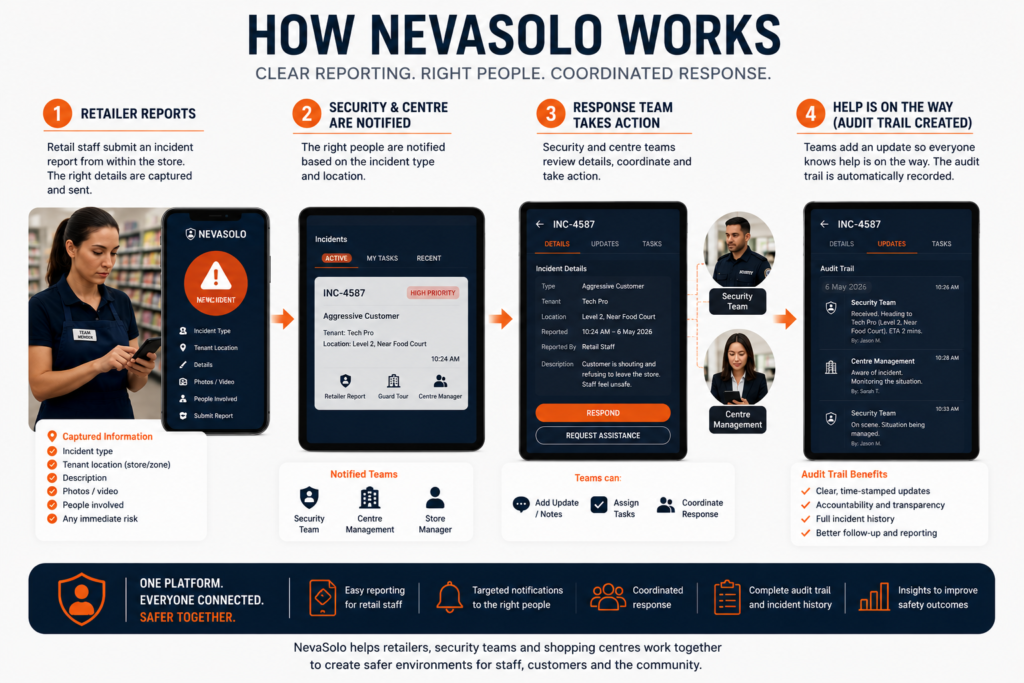
For retailers, NevaSolo Enterprise can help staff report safety-related incidents with more confidence.
For store managers, it can help create clearer records and follow-up.
For security teams, it can provide better incident context.
For shopping centres, it can improve tenant-to-security coordination.
For head office or brand-level teams, it can help identify patterns without interfering with on-site response.
NevaSolo Enterprise is especially relevant where:
- incidents are reported inconsistently
- responsibility is unclear
- communication is fragmented
- documentation is incomplete
- resolution is difficult to track
These are common problems in real retail environments.
Retail worker safety Australia-wide is not about creating fear. It is about giving staff, managers, security teams and shopping centres a clearer way to act when something happens.
Stay Connected When It Matters Most
Retail workers deserve to feel supported at work.
Retailers and shopping centres cannot control every customer interaction, but they can control how quickly staff can raise concerns, how clearly incidents are escalated, and how well the response is documented.
NevaSolo Enterprise helps retailers, shopping centres and security teams create a clearer pathway from incident report to response and resolution.
When something happens, the right people should know sooner.
The worker should know the issue has been seen.
Security should receive useful information.
Managers should have a clear record.
Centre teams should have better visibility.
That is how retail worker safety becomes more than a policy. It becomes a practical, everyday system that helps people feel safer doing their job.
Frequently Asked Questions About Retail Worker Safety Australia
What is retail worker safety Australia?
Retail worker safety Australia refers to the physical and psychological safety of retail workers across Australian stores, shopping centres, supermarkets, pharmacies, convenience stores, petrol stations, fashion stores, fast food outlets and other customer-facing retail environments. It includes protection from abuse, threats, harassment, violence, unsafe work conditions, lone work risks and poor incident response.
What should retail workers do if a customer becomes aggressive?
Retail workers should stay calm, create distance, avoid physical confrontation, alert a manager or security, move other people away if safe, and call Triple Zero on 000 if there is immediate danger, a serious injury or a crime in progress.
Is customer abuse a workplace safety issue?
Yes. Customer abuse can be a workplace safety issue because violence and aggression can cause physical and psychological harm. Safe Work Australia says workplace violence and aggression includes being abused, threatened or assaulted at work or while working.
When should retail workers call security?
Retail workers should call security when behaviour is escalating, a customer is threatening or intimidating staff, suspected theft creates a confrontation, someone refuses to leave, a person is loitering or following staff, or workers feel unsafe.
When should retail workers call Triple Zero?
Retail workers should call Triple Zero on 000 when someone is seriously injured, urgent medical help is needed, life or property is being threatened, or a serious accident or crime has just occurred.
Why do retail workers not report abuse?
Retail workers may not report abuse because the process is too complicated, they are busy, they fear blame, they are unsure what counts as reportable, they think nothing will happen, or abuse happens so often that only serious incidents are reported. WorkSafe Victoria identifies underreporting as a common issue in aggression and violence reporting.
How can retailers improve retail worker safety?
Retailers can improve retail worker safety by training staff, reducing lone work where possible, improving lighting and visibility, making escalation pathways clear, ensuring workers can call for assistance, encouraging incident reporting, reviewing trends and supporting staff after incidents.
How can shopping centres improve retail worker safety?
Shopping centres can improve retail worker safety by making tenant-to-security reporting simple, using clear escalation pathways, improving zone visibility, keeping tenants informed during incidents, documenting actions and coordinating better between retailers, security teams and centre management.
What is a retail incident reporting system?
A retail incident reporting system helps staff record and escalate safety-related events such as abuse, threats, theft, suspicious behaviour, medical incidents, hazards and security concerns. A good system captures what happened, where it happened, who was notified, what action was taken and whether follow-up is required.
How does NevaSolo Enterprise help retail worker safety?
NevaSolo Enterprise helps retailers, shopping centres and security teams coordinate safety-related incidents through structured reporting, targeted notifications, role-based visibility, responsibility assignment, notes, updates and resolution tracking. This helps staff raise concerns earlier and gives managers and security teams clearer information during active incidents.
Final Word: Retail Workers Should Not Feel Alone at Work
Retail workers are often the first people to deal with customer frustration, aggression, theft, threats and unsafe behaviour.
They should not have to manage those moments alone.
Retail worker safety Australia-wide will improve when staff are trained, escalation is clear, reporting is simple, managers follow up, security receives better information and shopping centres treat safety as a shared responsibility.
The goal is not panic.
The goal is confidence.
When a worker knows how to raise the alarm, when security knows what is happening, when managers can see the record, and when centre teams can coordinate across tenants, retail environments become safer, calmer and more supportive places to work.

1 Comment
Shopping Centre Communication: Connect Tenants & Security · 10/10/2026 at 6:35 pm
[…] each participating tenant a clear reporting route, current staff access and a defined way to receive relevant operational updates. Make that process part of […]