Understanding how safe people actually feel walking alone at night in Australia is more important than ever. While many safety articles focus on tips and advice, very few bring together real data that shows what is actually happening across the country.
This page compiles the latest Australia night safety statistics, including how safe people feel walking alone after dark, public transport safety at night, and key risk factors linked to real incidents. All data is sourced from official Australian and international datasets, so it can be used for research, reporting, or personal awareness.
Whether you are commuting home, travelling at night, or simply want to understand the real risks, this guide breaks down the numbers clearly and practically.
Before we dive into the stats, get NevaSolo Personal on your phone and add your Trusted Contacts.
Key Australia Night Safety Statistics (2026)
- 85% of women and 94% of men who walk alone after dark report feeling safe
- 63% of women choose not to walk alone at night, with over one-third avoiding it due to safety concerns
- Only 68% of women feel safe waiting for public transport at night, compared to 93% of men
- 40,000+ sexual assault victims were recorded in Australia in the latest reporting year
- Late-night assaults (10pm–2am) are significantly more likely to involve alcohol compared to daytime incidents
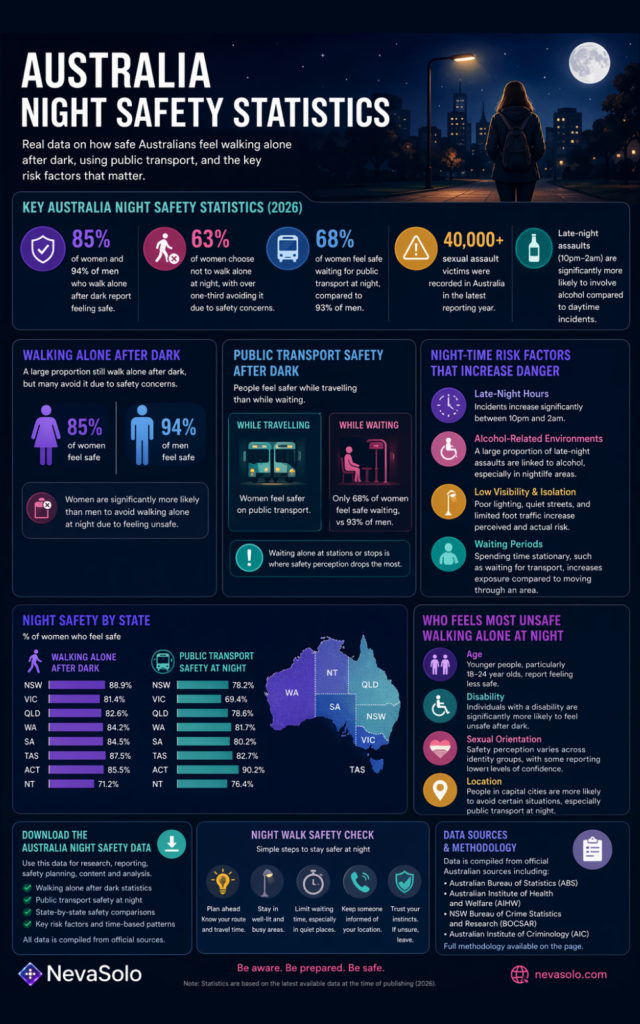
These figures highlight a clear gap between perceived safety, behaviour, and actual risk factors in Australia.
Walking Alone After Dark in Australia
Walking alone at night is one of the most commonly measured indicators of personal safety perception.
In Australia:
- Millions of people still walk alone after dark regularly
- A large proportion report feeling safe while doing so
- However, a significant percentage actively avoid walking alone due to safety concerns
This difference between those who feel safe and those who avoid the situation altogether is important. It shows that safety is not just about incidents, but also about perception and behaviour.
Women are significantly more likely than men to avoid walking alone at night due to feeling unsafe. This behavioural avoidance is one of the strongest indicators of perceived risk across the population.
Public Transport Safety After Dark
Public transport introduces a different type of safety concern compared to walking alone.
Data shows that:
- People generally feel safer while riding public transport than waiting for it
- Waiting alone at stations or stops is where safety perception drops most significantly
- Women report much lower safety levels while waiting compared to men
This “waiting vs travelling” gap is one of the most important insights in night safety data.
It highlights that risk is not just about movement, but about exposure, visibility, and time spent in isolated environments.
Night-Time Risk Factors That Increase Danger
Beyond perception, data also shows clear patterns in when and where incidents are more likely to occur.
Key risk factors include:
Late-Night Hours
Incidents increase significantly during late-night periods, particularly between 10pm and 2am.
Alcohol-Related Environments
A large proportion of assaults during late-night hours are linked to alcohol, especially in nightlife areas.
Low Visibility and Isolation
Poor lighting, quiet streets, and limited foot traffic increase perceived and actual risk.
Waiting Periods
Spending time stationary, such as waiting for transport, increases exposure compared to moving through an area.
These factors do not guarantee danger, but they consistently appear in both perception data and incident reporting.
Night Safety by State in Australia
Safety perception is not the same across Australia. Data shows clear differences between states and territories when it comes to feeling safe walking alone after dark and using public transport at night.
Walking Alone After Dark (Women Who Feel Safe)
- New South Wales: 88.9%
- Victoria: 81.4%
- Queensland: 82.6%
- Western Australia: 84.2%
- South Australia: 84.5%
- Tasmania: 87.5%
- ACT: 85.5%
- Northern Territory: 71.2%
Public Transport Safety at Night (Women Who Feel Safe)
- New South Wales: 78.2%
- Victoria: 69.4%
- Queensland: 78.6%
- Western Australia: 81.7%
- South Australia: 80.2%
- Tasmania: 82.7%
- ACT: 90.2%
- Northern Territory: 76.4%
These differences highlight how environment, infrastructure, and population density can influence safety perception across regions.
Who Feels Most Unsafe Walking Alone at Night
Safety perception is not evenly distributed across the population.
Age
Younger people, particularly those aged 18 to 24, report feeling less safe walking alone at night compared to older age groups.
Disability
Individuals with a disability are significantly more likely to feel unsafe in after-dark situations.
Sexual Orientation
Safety perception also varies across different identity groups, with some reporting noticeably lower levels of confidence when walking alone at night.
Location
People living in capital cities are more likely to avoid certain situations, particularly public transport at night, compared to those in regional areas.
These differences are important because they show that safety is not just about location, but also about personal context and experience.
Download the Australia Night Safety Data
To make this information easier to use, the key datasets have been structured for download and reference.
You can use this data for:
- Research and reporting
- Academic work
- Safety planning
- Content and analysis
Available Data
- Walking alone after dark statistics (Australia)
- Public transport safety at night (Australia)
- State-by-state safety comparisons
- Key risk factors and time-based patterns
All data is compiled from official sources and presented in a simplified format for practical use.
For citation purposes, please reference this page along with the original data sources listed below.
Data Sources and Methodology
This page compiles data from multiple official and research-based sources to provide a clear picture of night safety in Australia.
Primary sources include:
- National survey data on personal safety and behaviour
- Recorded crime statistics from official reporting systems
- Research on night-time risk factors and environmental conditions
- Public transport safety and incident reporting
It is important to understand that:
- Survey data reflects how safe people feel, not just what happens
- Recorded crime data reflects reported incidents, not all incidents
- Different datasets may use different definitions of “night” and “safety”
By combining these sources, this page provides both perception-based and incident-based insights into night safety.
All statistics are presented in a simplified format for readability while maintaining accuracy.
Night Walk Safety Check (Quick Self Assessment)
Use this quick check to assess your situation before walking alone at night.
Ask yourself:
- Is it late at night (after 10pm)?
- Are you walking alone?
- Is the area well lit?
- Will you need to wait for transport?
- Is your phone battery above 20%?
- Does someone know where you are going?
How to interpret your situation:
- Low risk: Early evening, well-lit area, people nearby
- Medium risk: Some isolation, moderate lighting, limited movement
- Higher risk: Late night, quiet area, low visibility, waiting alone
This is not about creating fear. It is about awareness. The more of these factors that apply, the more important it is to stay alert and prepared.
How to Stay Safe Walking Alone at Night
Understanding the data is one part of the equation. Knowing what to do is the next.
If you want practical steps you can follow before and during your walk, read our full guide:
👉 How to Stay Safe Walking Alone at Night in Australia
This includes simple actions you can take to reduce risk and feel more confident when moving through different environments.
How Technology Is Changing Personal Safety
One of the biggest gaps highlighted by night safety statistics is the difference between awareness and action.
In many situations, people know what they should do, but reacting quickly in the moment is harder.
This is where personal safety technology is becoming more important.
Instead of relying on memory or reacting under pressure, some people use tools that allow them to:
- Share their live location with trusted contacts
- Alert someone instantly if something feels wrong
- Keep a record of their movement during a safety session
This adds a layer of support that goes beyond individual awareness.
It does not replace good decision-making, but it can help reduce risk and improve response time in uncertain situations.
Frequently Asked Questions
Is it safe to walk alone at night in Australia?
Most people report feeling safe, but a significant number avoid walking alone due to safety concerns. Risk varies depending on time, location, and environment.
Why do people feel unsafe walking alone at night?
Common reasons include low visibility, isolation, unfamiliar surroundings, and past experiences. Data shows these factors influence both perception and behaviour.
Is public transport safe at night?
People generally feel safe while travelling, but less safe while waiting. Waiting alone in quiet areas is one of the biggest safety concerns.
What time is considered high risk at night?
Late-night hours, especially between 10pm and 2am, are associated with higher incident rates and increased risk factors.
What is the safest way to travel at night?
Planning ahead, staying in well-lit areas, limiting waiting time, and keeping someone informed of your location are key factors in reducing risk.
Final Thoughts
Night safety in Australia is shaped by both real-world incidents and how people perceive risk.
The data shows that while many people feel safe walking alone after dark, a large number still change their behaviour due to safety concerns.
Understanding when and where risk increases allows you to make better decisions and stay more aware in different situations.
Preparation, awareness, and the right tools can all play a role in improving personal safety after dark.
0 Comments